8 x built-in LEDs lights; Snapshot and video recording function; 10x to 220x magnification (2000x digital zoom) £ 249.95. VEHO VMS-001 USB MICROSCOPE DRIVERS FOR MAC - Share your thoughts with other customers. To startup 'guvcview' so that it recognizes the USB microscope instead of a web cam or other video device and so that it is ready to take still images rather than video, I made a startup script called 'guvc. It doesn't need to stay on a desk. Published 8 months ago.
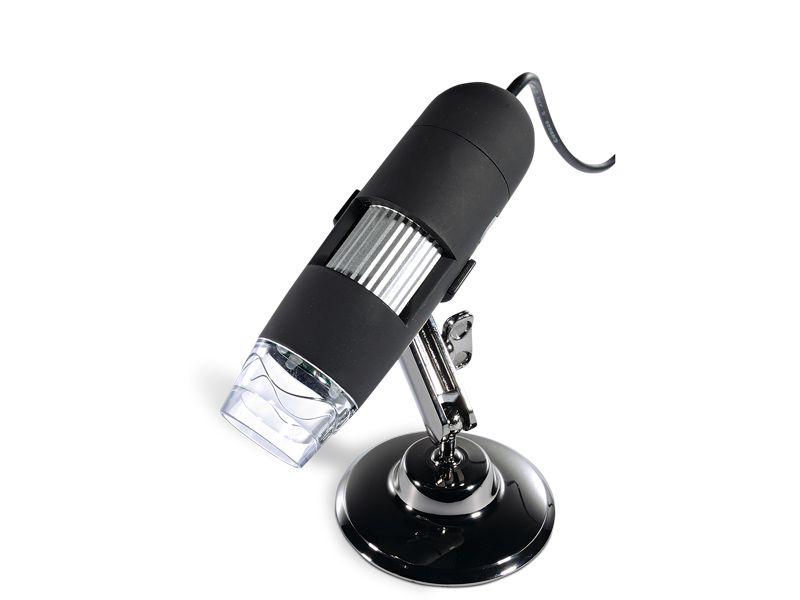
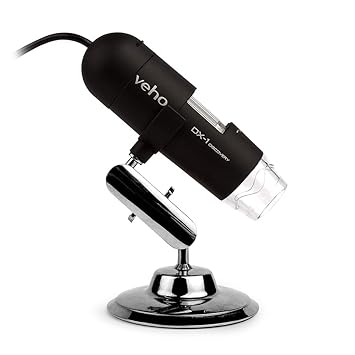
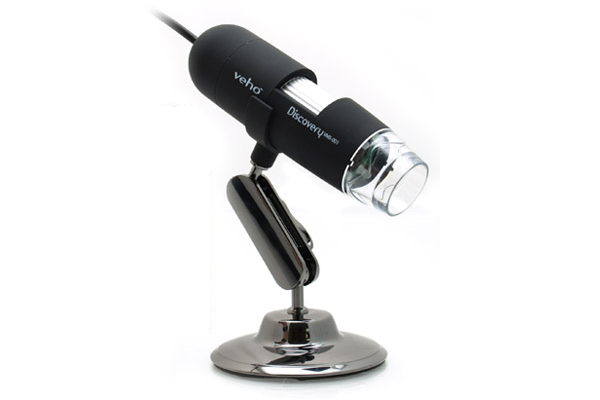
Veho Discovery DX-3 USB Digital 2MP Microscope The DX-3 USB microscope is capable of up to 2000x magnification (digital) and Full HD 1080p video output. Equally at home when used in the office or ready for use out 'in the field' thanks to the built-in rechargeable battery. Veho's VMS-004D 400x USB Microscope is a compact and ergonomic handheld digital illumination tool that will assist you in your scientific studies and observations. For convenience and to free you hands, place it on the included metal stand with articulating arm, which can be arranged to point in any desired direction. Yes the Veho Discovery microscope is Mac compatible. In fact Apple is one of the biggest customers using in their labs for inspection of water damaged iPhones. Regards, Veho Lifestyle Shop see less Hi Olivia, Yes the Veho Discovery microscope is Mac compatible.
the Veho VMS-001as used on a Linux PC,with 'guvcview' |
Home >RefInfo menu >
Computer topics menu >
This Veho Digital Microscope (on Linux) page
! Note !
Some information (and images and links) may be added,
if/when I re-visit this page.
Sections below:
INTRODUCTION (to the microscope)
Viewer-SOFTWARE (for Linux - 'guvcview')
SCRIPT (for running 'guvcview')
IMAGES (captured using 'guvcview')

Veho Vms 001 Driver
Introduction : The Veho VMS-001 'USB microscope' is a low-cost (less than $60) microscopethat can be plugged into a USB port on a personal computer to view smallobjects with a 20 to 200 factor of magnification. There are better microscopes that facilitate precise and non-frustrating focusing(frustration is discussed below), but they generally cost about $170 or more. Facebook apk download android. The microscope has 8 built-in LED lights that provide good lighting of theobject. There is a dial that can be used to adjust the amount of lightshining on the object. You can capture still images in the JPEG image file format, and you cancapture videos in the AVI video file format. (You can use software onyour computer to convert the image and video files to other formats.There are many such conversion programs [free] available for the Linuxoperating system.) You can see some examples of static image captures in theIMAGES section below. The three main controls on the microscope (other than the double-jointed stand,used to adjust the distance from the microscope aperture to the object of interest)are
The snapshot button is rather useless because it moves the microscope whenyou try to take a picture. This is reported to result in fuzzy pictures.It is better to use the image-capture button of the software for youroperating system to capture an image. You will need the brightness control dial and the knurled focus-knob,but they have the disadvantage of moving the microscope when you try to turn them.Neither of them is easy to turn. The knurled focusing-knob on mine is especially hard to turn,so if you have spent a lot of time positioning the microscope (with the double-jointedstand) and positioning your specimen (on a slide or jar lid or whatever),it is especially frustrating when you undo the positioning by trying to rotate theknurled knob to focus properly -- or by trying to rotate the brightness dial to changethe lighting. FEEDBACK to low-cost USB Microscope makers: Microscope documentation : A user manual for the Veho VMS-001 can be seen via this 25-pagePDF file. In particular, note that the Veho manual says it supports Still captureresolutions of: 2560x2048 (5M interpolated), And the Veho manual says it supports the same Video capture resolutions. Unfortunately, many people report that they have only been able to achieve a maxof 640x480 resolution. I have had the same experience (up to 2010 Aug 07) whenusing the 'guvcview' software on Linux (described below)to control image captures. If I find a combination of parameters that overcomes that limitation, I plan toreport it on this web page. Here is a video showing a 2 minute demo of the microscope. Microscope software The Veho microscope comes with a small CD disc that holds the PDF manual andtwo installations of image capture software: one for MS Windows computers andone for Mac computers. The Veho manual spends most of its pages describing the use of the user interfacesof these two installations of the image capture software. Since I use the software on a Linux computer (using Ubuntu 9.10) and since thereis no detailed description of how to use the microscope under Linux, I provide such adesription below, using the 'guvcview' program that is easily installed on UbuntuLinux with a few mouse clicks --- via the 'Ubuntu Software Center' option. (Before buying the microscope, I found some postings on the internet where peopleannounced that they were able to use the Veho VMS-001 USB microscope on theirLinux machines. For example, the Veho VMS-001 is said to be usable under Linuxat thisreviews page at freelabs.com.) (By the way, I bought the microscope via phone order atJ and R Inc. of New York City --- $60 in July 2010.) The image capture information is in the following categories, on this page :
Instead of using this menu of categories (sections) to go to a sectionand then scanning that section for information, you canuse the 'Find text' option of your web browser to find phrases of interest,such as 'veho' or 'microscope' or 'image' or 'focus' or 'video' or'audio panel' or 'guvcview' or 'script' or '/dev/' or '/bin/' or whatever. |
Viewer-SOFTWARE : ('guvcview' on Linux) Here are images of the three control panels of the 'guvcview' program for Linux:an image panel, a video panel, and an audio panel --- which are accessible inone window. In addition, there is a separate viewport window in which the still (or moving)image of the microscope subject can be seen.
Here is how I use the panels, to capture still images:
Launching 'guvcview' : To startup 'guvcview' so that it recognizes the USB microscope (instead ofa web cam or other video device) --- and so that it is ready to take stillimages rather than video, I made a startup script called 'guvc.sh'. I will describe the script contents in another section below. You can simplyhighlight and paste that code into your own script file on your own Linux computer. When one has the script file ready,it is easy to make an icon on your desktop to launch the script --- whichimmediately brings up the 'guvcview' control panel window and theviewport window. The viewport window immediately shows the image that the microscopeis capturing. (The following images, that show how to make the desktop icon, were captured on anUbuntu 9.10 PC, using the Gnome desktop environment.) You simply right-click on the (Gnome) desktop and choose the 'Create Launcher ..' optionfrom the popup menu. Here is an image of that popup menu. When you choose 'Create Launcher..', you are presented with this Create Launcherpanel, in which you enter a name for your icon and the fully-qualified name ofthe script file that you want to launch by double-clicking on the desktop icon. Here is the help that you get for 'guvcview' by entering the command'guvcview -h' at a command prompt in a terminal window on Linux: |
The 'man' help that you get by using the command 'man guvcview' is slightlydifferent from the built-in help. For easy reference, I make that 'man-help' available inthis 'man-help' text file. You can sometimes get additional insight into parameters used by a program by applying theLinux/Unix 'strings' command to the executable --- to see the human-readable stringsin the executable. For easy reference, I make the output of the 'strings /usr/bin/guvcview'command available inthis 'strings' text file. As a further note on the run-parameters of 'guvcview': I found that the 'guvcview' program saves its default run parameters (and changes that youmake to them when you use the program) in 'rc' (run control) hidden files in your homedirectory. In fact, for a video device assigned to /dev/video0, 'guvcview' createsa '.guvcviewrc' file. And if there is a second video device assigned to /dev/video1,'guvcview' creates a '.guvcviewrc-video1' file. In my case, the /dev/video0 device corresponded to a USB webcam -- a Logitech C500.And the /dev/video1 device corresponded to the Veho USB microscope. For easy reference, here is a sample image of a '.guvcviewrc-video1' file which corresponded to the Veho VMS-001 USB microscope. Shadow of the colossus iso torrent. For completeness, here is a sample image of a '.guvcviewrc' file which corresponded to the Logitech C500 webcam. I see that, in the '.guvcviewrc-video1' file, there is a 'sound=' parameter thatcan be set to 0 or 1. There does not seem to be such a parameter option via theguvcview command line options. It would be handy to specify something like '-a 0'to indicate that no sound recording is wanted. The initialization messages comingfrom 'guvcview' indicate that it spends a little processing time, during startup,trying to determine if sound recording should be done. Here is a sample of 'guvcview' messages from when the program starts up. Note thatthere are four 'bt_audio_service_open: connect() failed: Connection refused (111)' messages at the beginning, indicating thatthe progam is trying to setup sound recording. I use several of the 'guvcview' command-line parameters ---notably '-d', '-s', '-m', and '-t' ---to formulate the 'guvcview' command within the launcher script. See the scriptin the next section. |
SCRIPT : (for running 'guvcview') Here is an image of the script that I am using to run 'guvcview' with suitablestartup parameters. |
The bottom part of the script, after the 'exit' statement, is simply comment linesto help me remember what I did --- and what I might want to try in the future. You can paste this code into your own script file on your PC. Remember to makethe script executable. For example: you can use the command chmod 755 guvc.sh at terminal window command prompt --- after positioning yourself in the directoryin which you placed the script file. Alternatively, if you are using the Nautilus file manager, you can right-clickon the 'guvc.sh' file, choose 'Properties', and use the 'Permissions' panelto make the file executable. Happy image capturing! |
IMAGES :
Note that there is a 'depth of field' effect. For contrast, the salt was put on a dark background |
Veho Discovery Camera
Bottom of this To return to a previously visited web page location, click on theBack button of your web browser, a sufficient number of times.OR, use the History-list option of your web browser. < Go to Top of Page, above. > |